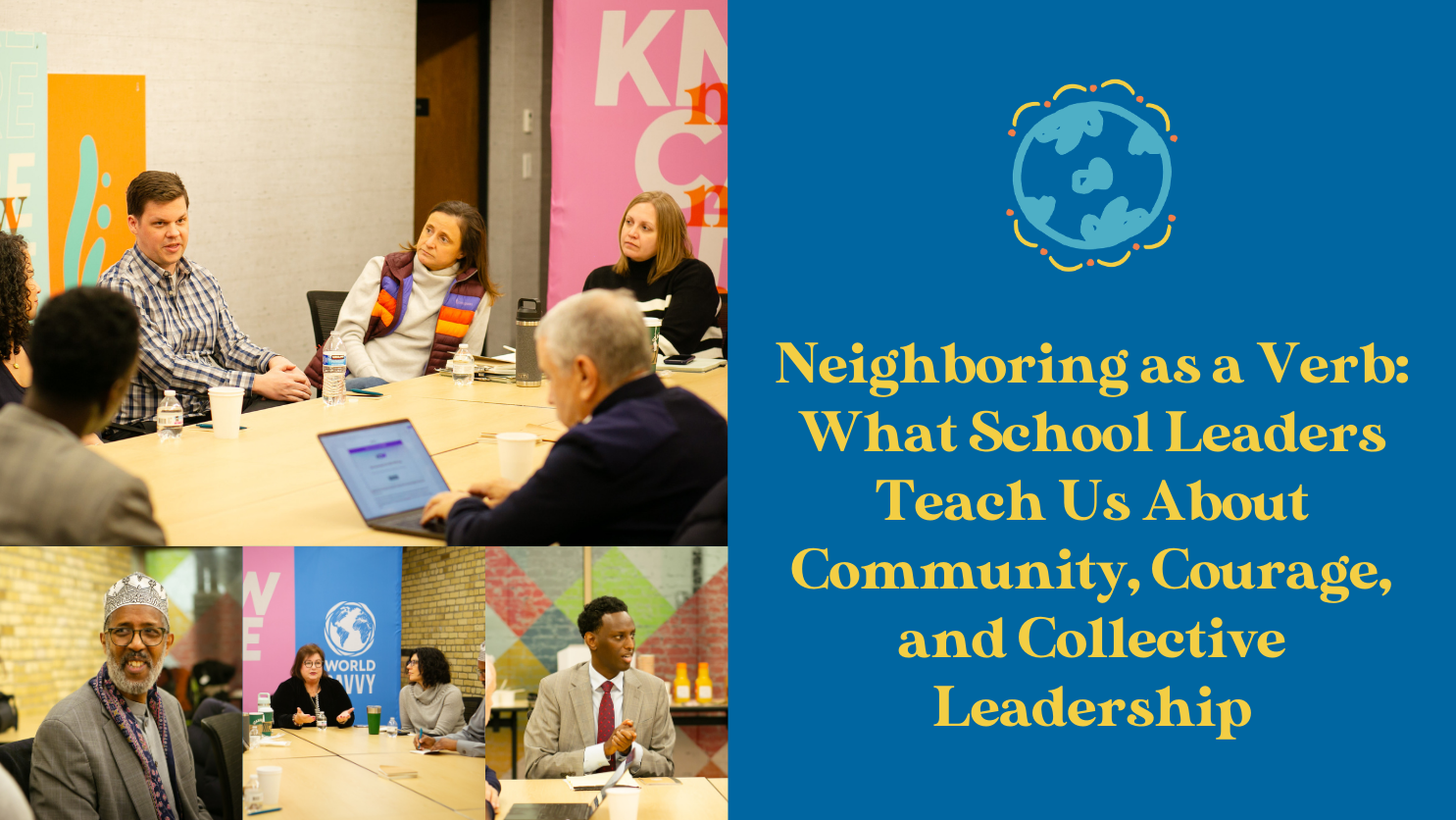
Last week, we convened school leaders, community partners, and neighbors from across Minnesota for a conversation about what’s unfolding in our districts right now. It was not a press event or panel. It was a space to listen, reflect, and learn together.
At World Savvy, this kind of space, where multiple perspectives are elevated, where people can listen deeply, reflect honestly, and learn from one another, is at the core of how we work alongside schools and communities. It is how we make sense of complex moments and move forward with greater clarity and shared purpose.
The Joy After Two Months Inside
Hope Fagerland, Assistant Superintendent of St. Anthony-New Brighton School District, shared a story that quietly carried the weight of this moment.
One family in her district had not left home for two months, continuing learning remotely out of fear. Then they called their principal with a simple request: they wanted to attend the school’s Fun Fest.
The story lingered because it revealed something essential: when fear constricts daily life, schools can gently widen it again. They become bridges back to belonging, and belonging is foundational to learning.
Different Levels of Innocence
Laurie Putnam, Superintendent of St. Cloud Area Schools, described what she called “different levels of innocence.” In a diverse and politically divided community, she has watched people encounter realities that are new to some but long familiar to others.
After a tense local moment, a Somali community member told her husband, a state senator, “This is not my first civil war.” The room fell quiet.
For some residents, recent events felt shocking. For others, they reflected lived experience. Schools, Laurie noted, are often where these realities meet, where communities learn to listen across difference rather than retreat from it.
Nearby districts faced similar moments through different lenses. Leaders chose to center humanity over headlines, telling stories that helped communities see families, not narratives. This is neighboring at the leadership level, and democracy practiced through care.
Neighboring as a civic responsibility
Our guest Thomas Friedman said he recently heard a friend say; “There are hundreds of leaders of this movement, and I don’t know a single one of their names.”
The stories that followed proved this point.
A Minneapolis social worker helped mobilize $300,000 in rent support through grassroots networks. Community members distributed food and resources during Ramadan. School leaders worked quietly to sustain trust with families navigating fear and uncertainty.
None of these efforts centered a single hero. Leadership was shared — across educators, neighbors, faith leaders, and families.
When leadership is distributed across ordinary acts of care, it becomes culture. Neighboring, in this sense, is not sentimental. It is civic responsibility. Democracy thrives when people actively care for one another’s lived realities, and schools remain at the center of that practice.
Schools at the Center of Civic Life
As the conversation unfolded, a pattern became unmistakable. When uncertainty rises, families turn to schools. They call principals. They look to superintendents. They trust teachers to help their children make sense of the world.
Whitney McKinley, Chief Program Officer at World Savvy, named at the outset that this gathering itself reflected how we work alongside schools. We create space for multiple perspectives. We foster inclusive dialogue. We support leaders in navigating complexity together rather than in isolation.
These are not abstract ideals. They are civic competencies. The ability to listen deeply. The willingness to consider perspectives different from one’s own. The discipline to collaborate across difference. The courage to problemsolve collectively rather than fracture individually.
In classrooms and district offices across Minnesota, those competencies were not theoretical. They were practiced in real time.
Schools are not peripheral to democracy. They are where it is rehearsed daily in relationships, in conversations, and in decisions about how to respond to complexity.